You Can’t Do Everything at Once: Why the LEA Uses a Semi-Ipsative Questionnaire
Maria Brown, Ph.D., BCC
Key Takeaways
- Leaders make choices throughout the day about which behaviors to emphasize, based on their goals, priorities, circumstances, and available resources.
- MRG’s semi-ipsative questionnaire reflects this decision-making process by asking people to make choices among behaviors rather than rating everything independently.
- The LEA combines these choices to reveal which of 22 leadership behaviors people tend to emphasize more or less in their work.
Leadership Is a Series of Choices
The other day, my six-year-old and I were getting out of the car. I had somehow ended up carrying his water bottle, my water bottle, the car keys, my purse, the mail, and a toy that had been riding around in the car for far too long. He was carrying a book and a pencil.
Apparently, that was too much for him, because he asked me for help. I asked him to take a good look at everything I was holding and tell me whether he thought I could possibly carry anything else. I explained that I was happy to trade something with him, but I couldn’t carry one more thing.
I’m not sure I convinced him. But this experience got me thinking about how often we make similar choices throughout the day. We have limited time, attention, and resources, and we have to decide where to direct them. The same is true of leadership.

Leaders Can’t Emphasize Every Behavior at Once
MRG’s Leadership Effectiveness Analysis (LEA) measures 22 leadership behaviors. All 22 have value, but that doesn’t mean leaders can, or should, emphasize all of them equally. What we do at any given moment depends on what is happening around us, what we’re trying to accomplish, our priorities, and the resources we have available.
Take the example of a sales executive preparing to introduce a new sales plan. As he develops the plan, he may spend considerable time analyzing options, thinking about the implications for different parts of the organization, and anticipating potential challenges. But when he meets with his sales team, his priorities may change. Now he needs to explain the plan, communicate expectations, and make sure everyone understands what it means for their work.
Both Strategic and Communication behaviors measured by the LEA are important. And they aren’t mutually exclusive. But the executive has to decide where to put most of his attention based on what he is trying to accomplish at each step.
A leader who continues analyzing every possible implication when the team needs clear direction may not be giving people what they need at that moment. We make these decisions all day long, often without thinking much about them.
How Does a Semi-Ipsative Questionnaire Reflect These Choices?
Think about what happens when we ask someone to rate how frequently they demonstrate a series of leadership behaviors. It’s easy to say that we do many of them regularly. And we probably do, at least across work situations. However, that doesn’t tell us much about what we are most likely to do when different behaviors compete for our attention.
MRG’s semi-ipsative questionnaire introduces an element of choice. Instead of rating each behavior independently, respondents are presented with groups of behavioral statements. They choose the statement that describes them best and indicate how strongly it fits. They then identify their next choice and indicate its strength. The format asks people to make distinctions among behaviors, even when more than one describes them well.
The questionnaire uses repeated comparisons to identify the behaviors they are most inclined to emphasize. In that sense, the process is similar to the decisions we make as we go about our work. We may value many different approaches, but we still have to choose where to focus our attention.
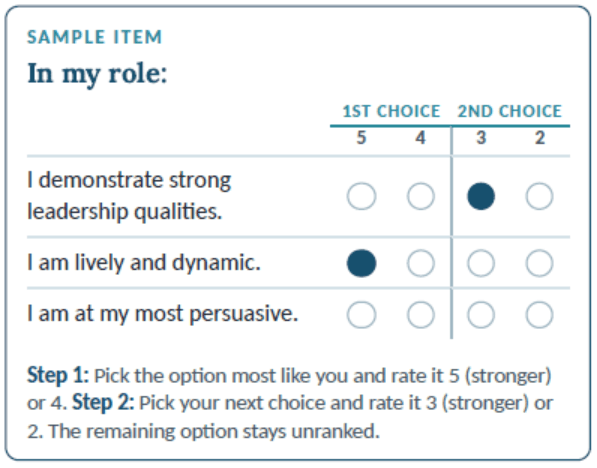
The MRG semi-ipsative questionnaire asks respondents to make choices among behavioral statements and indicate how strongly each choice describes them.
What Do All Those Choices Tell Us?
The LEA combines responses across the questionnaire to identify patterns in how someone approaches leadership. Some behaviors are consistently emphasized across many comparisons. Others receive relatively little emphasis. Still others fall somewhere in between. These patterns tell us something about what a leader is most likely to do across a variety of workplace circumstances.
When we compare those patterns with an appropriate norm group, we can see which behaviors a leader emphasizes more or less than others. A high score suggests that a behavior is a big part of someone’s leadership approach. A low score suggests that it is less characteristic of how they typically operate. A mid-range score indicates that the behavior has a place in their approach but isn’t as consistently used.
This doesn’t mean that a leader with a low score can’t demonstrate that behavior. For example, someone with a low Communication score may be very good at explaining complex ideas. They simply may not emphasize that behavior as frequently as other approaches to leadership. And a mid-range score may prompt us to explore when someone chooses to emphasize a behavior and when they don’t. The LEA measures patterns of behavior, not a person’s ability to demonstrate a particular behavior.
What Does This Mean for Leadership Development?
When we understand these patterns, we can have much more useful conversations about leadership development. Rather than assuming that high scores are always good and low scores are always bad, we can explore how someone’s typical approach fits the demands of their role. Which behaviors are helping them succeed? Are there situations where they rely too heavily on a familiar approach? Are there behaviors they could emphasize more to accomplish something important?
The goal isn’t to get high scores on all 22 behaviors. It’s to understand the choices leaders typically make and help them recognize when a different choice might serve them better. And that’s what I like about the semi-ipsative design. It measures patterns of behavior through a process that reflects something we all do every day: decide what deserves our attention and what we can set aside.
I couldn’t carry my son’s book without putting something else down. At work, the tradeoffs aren’t always quite as obvious, but they’re there. Understanding those choices gives leaders a better opportunity to make them intentionally.
Frequently Asked Questions
What is a semi-ipsative questionnaire?
A semi-ipsative questionnaire asks respondents to make relative choices among statements while also indicating how strongly those statements describe them. This helps identify which behaviors a person tends to emphasize more or less.
How is a semi-ipsative questionnaire different from a traditional rating scale?
Traditional rating scales ask respondents to evaluate each statement independently. A semi-ipsative questionnaire asks respondents to compare statements and make choices, helping identify relative behavioral priorities while reducing some common response biases.
Does a low LEA score mean someone is ineffective at that behavior?
No. LEA scores describe how frequently someone tends to emphasize a behavior relative to a norm group, not their ability to demonstrate it. Whether a low score is important depends on the leader’s responsibilities, goals, and circumstances.
About the Author
Maria Brown, Ph.D., BCC, is Vice President of Assessment Science, Research & Education at MRG Assessments. A developmental psychologist and Board Certified Coach, she has spent more than 20 years studying human behavior. Her work combines research on leadership assessments with practical experience in executive coaching, helping leaders understand their behavior and make more intentional choices about how they lead.