How Compassionate Leaders Get Big Results Without Setting Big Goals
Christine Chasse
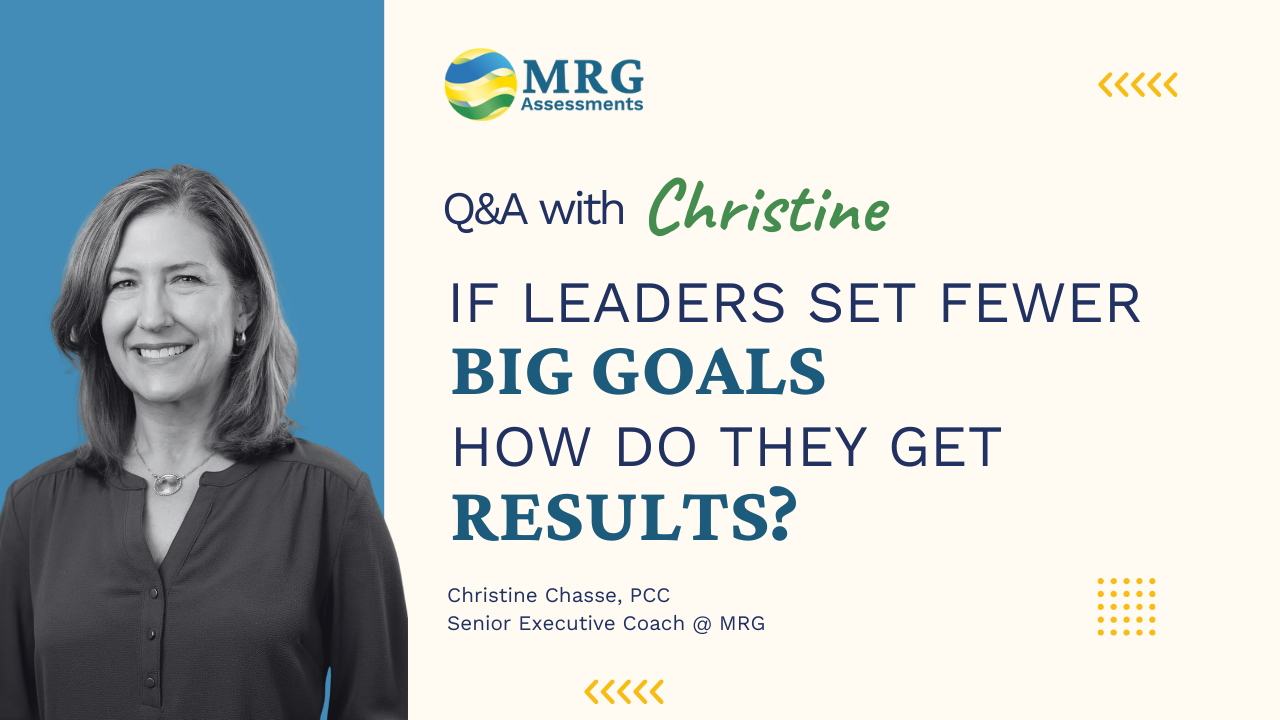
In a world that often equates leadership effectiveness with targets, metrics, and big initiatives, compassion can seem like a soft skill — nice to have, but not necessary for high performance. Yet research and real organizational outcomes paint a very different picture. Compassionate leaders, those who understand, connect with, and support people, consistently drive stronger engagement, performance, and long-term impact, even without setting big, dramatic goals.
At MRG, we define compassionate leadership not as indulgence or leniency, but as purposeful, perceptive action that builds trust, promotes psychological safety, and harnesses human motivation in ways that create tangible results.
Research shows that leadership compassion isn’t just a feel-good practice; it has a measurable impact. One recent study found that leaders who demonstrate compassionate behaviors create environments that enhance employee well-being, which in turn supports greater work engagement and psychological safety.
Other research highlights that compassion in the workplace helps employees weather stress and adverse conditions more effectively, strengthening resilience and performance.
What We Mean by “Compassionate Leaders”
Compassionate leaders pay attention to more than output. They pay attention to human experience: how people think, feel, and engage with their work and their teams. Key attributes of compassionate leaders include:
- Empathy: understanding others’ perspectives without judgment
- Responsiveness: acting to support people when challenges arise
- Connection: building trust through genuine presence and engagement
- Insight: recognizing what motivates others and how to channel it productively
Importantly, compassionate leadership is not soft. It insists on accountability, clarity, and performance, but it achieves these outcomes through alignment and understanding rather than command and control.
Why Compassionate Leadership Drives Results
Compassionate leaders help people feel seen, heard, and valued. And that foundation changes everything:
Psychological safety accelerates performance
When people feel safe, to take risks, share ideas, and speak up without fear, innovation and problem-solving flourish. Research consistently shows that environments high in psychological safety produce higher engagement and lower turnover. Compassionate leaders create that environment.
Engagement fuels discretionary effort
Employees who feel understood are more likely to go beyond what’s required. They bring their best thinking and creativity to the work because they feel their contributions matter. As a result, performance improves not because goals are bigger, but because people are more invested.
Alignment trumps aggressive goal setting
Big goals can inspire, but they can also overwhelm. Compassionate leaders focus teams on clarity of purpose, sustained progress, and relational support, which often drives performance as effectively as ambitious targets, and with less burnout and conflict.
The MRG Perspective: Motivation + Behavior Insights
At MRG, our work with organizations shows that compassion is closely tied to motivation. Leaders who understand what drives their people, and what sustains energy and engagement, are better positioned to co-create conditions for performance.
Two MRG assessments are especially relevant:
- Leadership Effectiveness Analysis™ (LEA): reveals how leaders’ behaviors are perceived, including relational influence
- Individual Directions Inventory™ (IDI): uncovers internal motivators and how they shape choices and engagement
When leaders combine insight from both tools, they gain a more reliable picture of how their behaviors land and why people respond the way they do.
For example:
- A leader perceived as directive may think they’re being decisive, but IDI insight might reveal that their motivational driver leans toward autonomy or results, influencing how they show up in interactions.
- A team that underperforms may not lack skills, but it may lack clarity about how its contributions connect to shared purpose.
Compassionate leaders use this kind of insight to bridge perception and reality, leading to stronger relationships and better outcomes without necessarily setting bigger goals.
Compassionate Leadership in Practice: Four Behavioral Patterns
Compassionate leadership isn’t abstract. It shows up in observable behavior. Leaders who practice compassion consistently use these patterns:
Active listening
Compassionate leaders don’t just hear words; they attend to context, emotion, and intent. This deep listening builds understanding and indicates respect.
Inquiry before advocacy
Rather than jumping to solutions, compassionate leaders ask questions that uncover assumptions and invite participation, helping others feel ownership in problem-solving.
Targeted support
Compassionate leaders respond to specific needs. They don’t offer generic praise; they coach to strengths, help remove barriers, and direct resources where they matter most.
Reflective action
Compassionate leadership is iterative. These leaders reflect on feedback, adjust behaviors, and model humility and continuous learning.
These behaviors drive results because they build trust, alignment, and engagement, which are fundamental to sustainable performance.
Compassion + Results: The Organizational Payoff
Companies that intentionally develop compassionate leadership — not for feel-good optics, but for strategic relational impact — report:
- Higher employee retention
- Stronger teamwork and cross-functional collaboration
- Better conflict resolution and decision quality
- Increased innovation and adaptability
Compassionate leaders help organizations absorb uncertainty without fracturing performance, a capability that is critical in volatile markets.
Coaching for Compassionate Leadership
One of the most effective ways to build compassionate leadership is through coaching that combines:
- Assessment data (behavior + motivation)
- Reflective dialogue (what is your impact teaching you?)
- Targeted experiments (try new behaviors with accountability)
- Feedback loops that track progress over time
When coaching is grounded in objective insight rather than intuition alone, leaders don’t just understand compassionate practices; they apply them meaningfully.
A Final Thought on Compassionate Leaders
Compassionate leadership succeeds because it plays to human nature: people respond to support, clarity, and recognition. Leaders who lead with compassion don’t achieve performance by decree. They achieve it through connection.
Big results don’t always start with big goals. Sometimes they start with a deeper understanding of people: their motivations, their experiences, and how they show up in the work that matters.
Compassionate leaders don’t just set direction. They set conditions for people to do their best work. And that makes all the difference.
Our research shows that highly compassionate leaders dial down the behavior “production”, characterized by setting ambitious goals and pushing for achievement. So how do they still deliver results? Watch the full on-demand webinar here.